

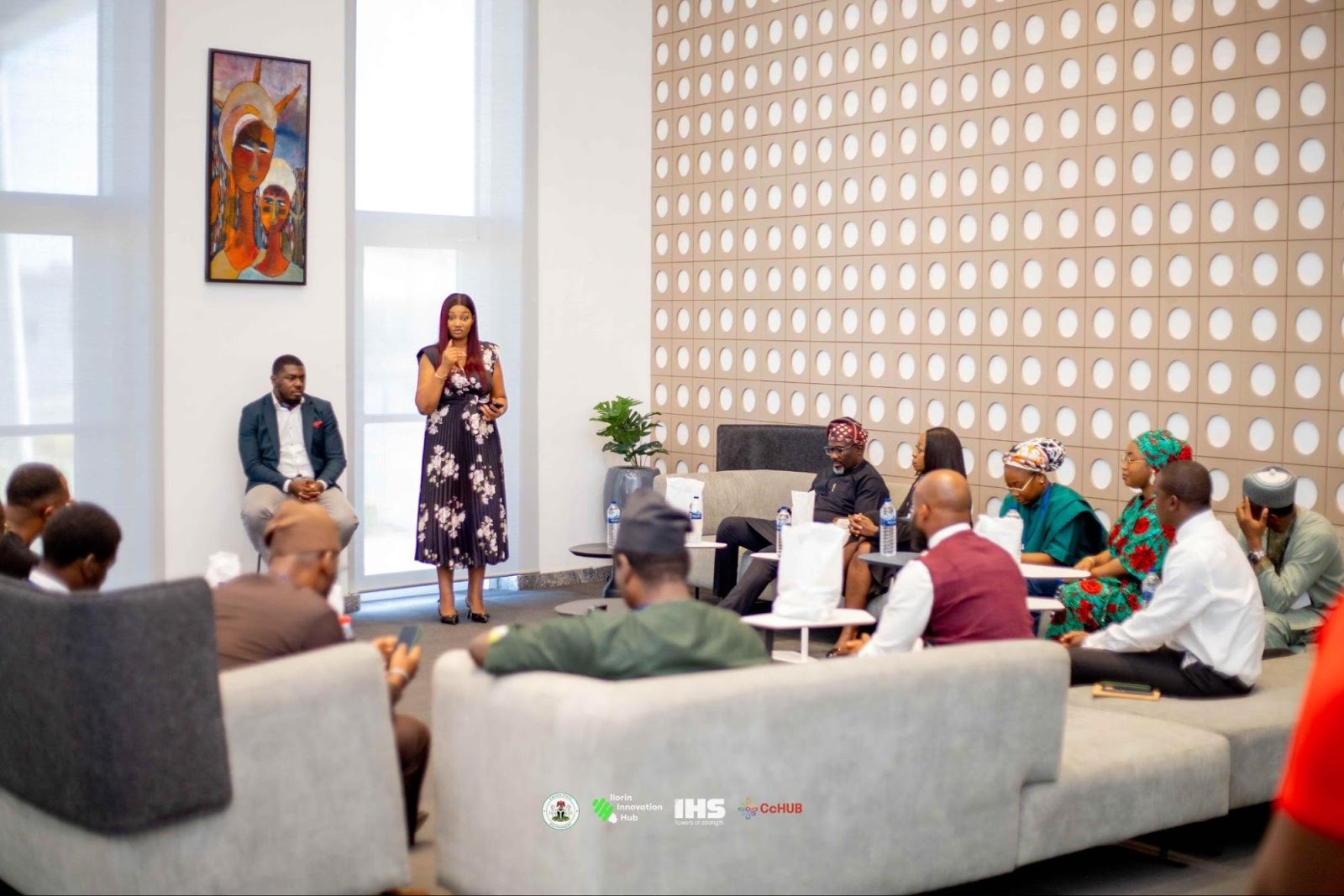
Photo: A session from the Kwara Digital Health Summit 2025
Innovation does not stall because of a lack of talent. It stalls because systems fail to connect talent to structure.
In Q4 2025, CcHUB focused on one strategic priority across Africa: closing the gap between potential and deployment.
Across education, digital health, startup infrastructure, creative industries, and democratic governance, the recurring pattern was fragmentation—disconnected actors, isolated builders, and misaligned incentives.
Our role was not to add more activity to the ecosystem.
It was to design alignment. Here is what that produced.
Education: Institutionalising Student Innovation
Universities across Africa produce ideas every semester. Few produce scalable solutions.
Through a strategic partnership between CcHUB’s EdTech Centre of Excellence and Tai Solarin University of Education (TASUED), we embedded structured innovation pathways inside a university ecosystem.
The result:
- 60+ student innovators engaged
- 22 teams applied
- 11 shortlisted
- 100% of shortlisted teams built working prototypes
- 3 teams progressed into incubation
- 350+ students attended Demo Day
This was not a pitch competition. It was capability transfer.
Problem Closed
Student innovators lacked:
- Product validation exposure
- Structured mentorship
- Institutional pathways for scaling ideas
Through mentorship, rigorous evaluation, and real-world pitching, students moved from abstract ideas to tested solutions addressing learning accessibility, inefficient academic workflows, and engagement gaps. Faculty feedback confirmed increased institutional confidence in student-led innovation.
CcHUB did not just support students, we strengthened TASUED’s innovation infrastructure.
Digital Health: Turning Fragmentation into Policy-Aligned Momentum
Digital health ecosystems often fail at the coordination layer.
In Kwara State, innovators, policymakers, investors, and academia operated in parallel, not alignment. The Kwara Digital Health Summit 2025—convened by CcHUB’s Design for Health Practice in partnership with the Ilorin Innovation Hub—was engineered to change that.
Impact:
- 125 stakeholders across government, private sector, academia, and innovation
- 5 structured sessions covering policy, collaboration, exhibition, investment readiness, and commitments
- Defined cross-sector commitments shaping Kwara’s digital health agenda
System-Level Problems Addressed
- Policy misalignment slowing adoption
- Founder readiness gaps limiting investment
- Weak coordination between ecosystem actors
The Investment Readiness Masterclass strengthened founders’ capacity around valuation and financial structuring. The Commitment Roundtable moved conversations into defined next steps. Participants described the summit as the first structured space that connected vision to implementation pathways in Kwara’s digital health ecosystem.
From Ecosystem to Execution: Mediloan
Deployment matters.
MyItura, part of the AI-DPI program, launched Mediloan — an AI-enabled telehealth financing platform addressing healthcare affordability.
- 100 healthcare and digital health leaders attended the launch
- Live onboarding and demonstrations conducted
Problem addressed: delayed payments and affordability barriers preventing care access. Mediloan enables structured patient financing while improving provider cash flow. Participants emphasized that solutions bridging financing and care delivery are critical to health equity.
CcHUB’s health work in Q4 demonstrated a complete arc: ecosystem alignment → founder capacity → solution deployment.
Startup & Innovation Infrastructure: From Visibility to Viability
Namibia: Structured Pathways to Market
Early-stage founders often lack credible validation.
CcHUB Namibia hosted a Product Showcase featuring four AI-driven startups addressing business intelligence, agriculture, education, and recruitment.
Outcomes:
- 4 startups presented market-ready solutions
- 2 secured business support commitments from Salt Essential IT
Major Partnership:
CcHUB Namibia formalized a partnership with the Bank of Namibia under the Fintech Youth Programme—equipping youth founders with regulatory insight and structured fintech support. This moved innovation beyond visibility into institutional backing.
Kenya: Compounding Ecosystem Value at iHUB
At iHUB Kenya:
- 22 new coworking members
- 224 events hosted
- 13 major partnerships
- 300+ storytellers supported across film, TV, and the Creator Economy
- 22 startups strengthened via Spark Accelerator and the Mastercard Foundation EdTech Fellowship
System gaps addressed:
- Limited access to innovation infrastructure
- Underrepresentation in media narratives
- Founder capability constraints
Through structured programming and partnerships, founders gained support across product, talent, distribution, and fundraising. Gender-equitable storytelling initiatives amplified diverse voices across Africa’s creative ecosystem.
Community Infrastructure: Solving Isolation Across Borders
Across Nigeria, Kenya, Rwanda, and Namibia, community builders face a shared challenge: working in silos. In Q4, CcHUB activated the Community of Community Architects simultaneously across four countries.
Impact:
- 88 community professionals engaged
- Practitioner database created
- Immediate cross-border collaboration observed
Participants reported reduced professional isolation and identified collaboration opportunities across health, finance, and tech communities. By formalizing peer infrastructure, CcHUB strengthened the connective layer that enables ecosystems to scale.
Tech & Society: Protecting Democratic Participation in the Digital Age
Innovation without safeguards undermines trust. In Q4, CcHUB convened multi-stakeholder dialogues addressing digital violence, electoral harm, and platform accountability.
Human Rights Day Roundtable
Focused on AI-driven harassment, deepfakes, and gendered disinformation targeting women.
Outcome:
- Strengthened advocacy alignment
- Clear calls for legal reform and platform accountability
- Commitment to inclusive digital safety design
Election Stakeholders Dialogue
Convened founders, civic tech leaders, and civil society to address democratic integrity ahead of Nigeria’s 2027 elections.
Consensus: civic resilience requires coordinated action, financial investment, and trust-building — not fragmented response.
Multilingual Digital Regulation Webinars
Delivered in Swahili, Portuguese, and French to expand digital policy dialogue beyond English-speaking audiences.
Participants called for:
- Stronger digital rights advocacy
- Increased civil society funding
- Practical digital security tools
This work reinforced CcHUB’s role in shaping safe, inclusive digital ecosystems across Africa.
What This Quarter Demonstrates
CcHUB’s impact in Q4 2025 is measurable:
- 100% prototype completion rate in university innovation
- 125 health stakeholders aligned under a shared agenda
- 2 startups securing direct institutional support
- 300+ storytellers advancing equitable narratives
- 88 community architects connected across four countries
- Multilingual digital rights engagement expanding continental access
But more importantly, it demonstrates something structural: CcHUB operates at the systems layer.
We design the connective tissue that allows:
- Ideas to become products
- Products to reach markets
- Communities to collaborate
- Policy to align with innovation
- Democracy to adapt to digital realities
Q4 2025 was not just a collection of programs and activities; it was coordinated ecosystem engineering. And that is the work required to move African innovation from potential to durable impact.