

A new study from Co-creation Hub (CcHUB) and the African Internet Rights Alliance (AIRA) shows that social media algorithms now function as electoral infrastructure across Africa, deciding which political messages voters see and which they never will — while electoral laws and observation missions remain entirely blind to them.
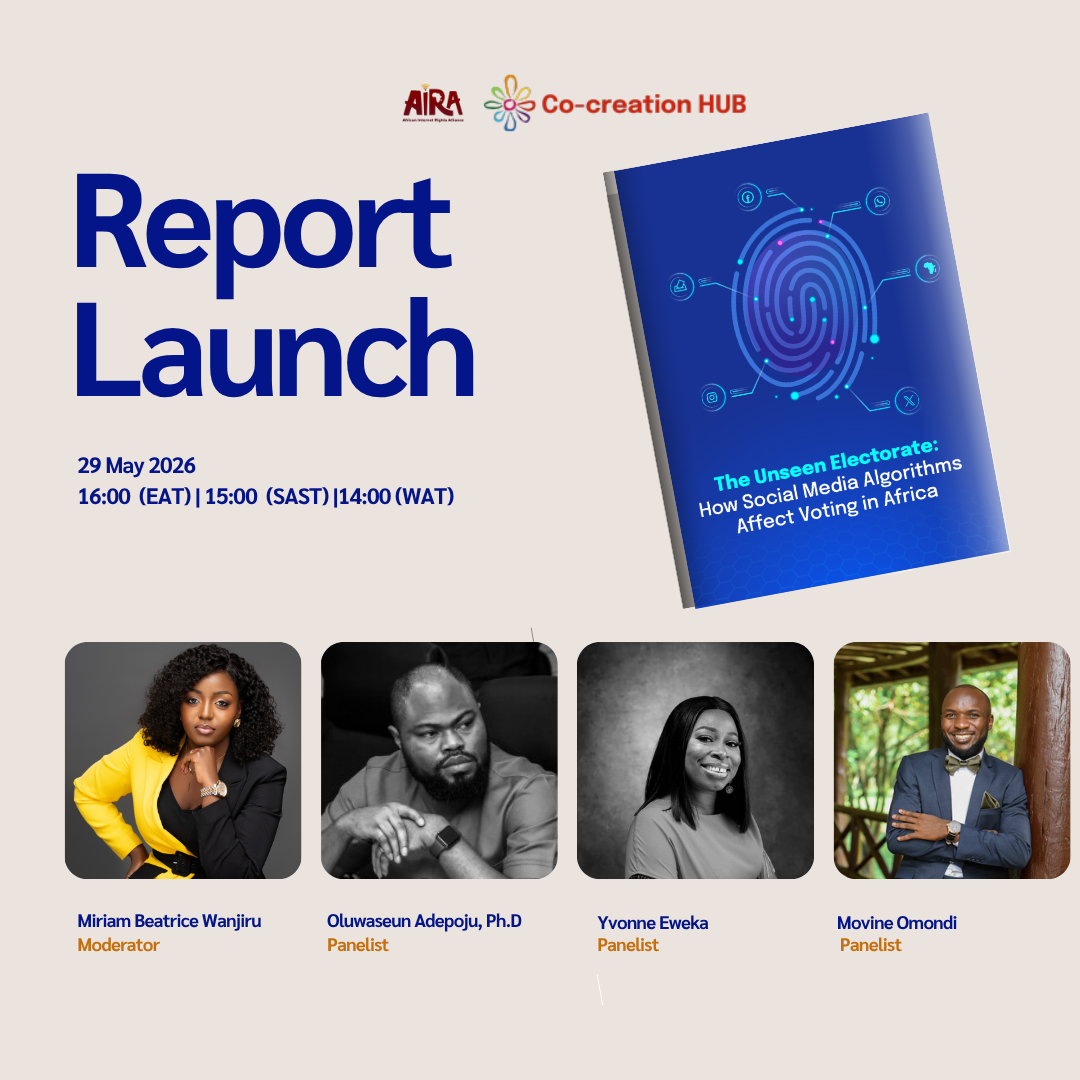
Every African election now has an actor that no observer mission monitors, no electoral law names, and no voter can see. It does not cast a ballot. It decides which candidates, claims, and narratives reach the people who do.
That actor is the recommendation algorithm. And according to The Unseen Electorate: How Social Media Algorithms Affect Voting in Africa — a new report by CcHUB’s Tech and Society programme, produced with support from AIRA — its influence is no longer theoretical. It is measurable, structural, and already shaping the conditions under which Africans vote.
The study draws on evidence from ten countries (Algeria, Angola, Chad, Côte d’Ivoire, Kenya, Namibia, Nigeria, Tunisia, Uganda, and Zimbabwe), expert interviews and a Pan-African focus group, and an original 75-day social media listening experiment running purpose-built accounts on X across Kenya, Nigeria, Namibia, and Uganda. The findings are consistent and uncomfortable.
Political content is force-fed, regardless of what users want. Across the four experiment countries, political posts achieved between 2.5 and 3.6 times the effective visibility of non-political posts. Accounts created with no political interest at all were still saturated with political content — in Namibia and Kenya, non-political accounts carried political-content densities barely below those of explicitly political ones. In practice, opting out of political content on these platforms is not an option African users are offered.
The algorithm rewards friction, not facts. Negative, polarising political content consistently travelled furthest. Across all four countries, the share of political content in users’ feeds roughly tripled as sentiment shifted from positive to negative. Substantive civic information was actively penalised: posts carrying real policy depth lost between 46.8% (Kenya) and 66.8% (Uganda) of their reach. The platforms are not broken. They are working as designed — and the design is hostile to the kind of deliberation elections require.
Attention is captured by a tiny elite. Political visibility on X showed Gini coefficients averaging around 0.78 — a level of concentration that means a tiny fraction of accounts absorbs the overwhelming majority of impressions, while local, community, and non-elite political voices are rendered effectively invisible.
This matters more in Africa, not less. The continent has younger and more first-time electorates, who are likelier to read algorithmic visibility as credibility. Platforms invest least in African-language moderation precisely where linguistic diversity is highest, leaving vernacular hate speech and ethnically targeted disinformation to circulate largely unchecked. Private platforms like WhatsApp and Telegram — where focus group participants said “the real dirt matches happen” — sit entirely outside oversight. And the most resourced candidates simply buy amplification, turning elections into contests over advertising budgets. The gendered cost is stark: the report documents how female candidates are made visible through manufactured scandal rather than policy, a form of algorithmic silencing.
The global precedent is already here. In Romania’s 2024 presidential election, one candidate’s TikTok content was recommended 4.6 to 14 times more often than his main rival’s, helping produce an unexpected first-round result. The report’s argument is that Africa’s structural exposure makes similar outcomes more likely, not less.
The response cannot be the analogue reflex of internet shutdowns and vague “false information” laws, which punish citizens while leaving the algorithmic drivers of harm untouched. Instead, the report calls on electoral management bodies, regulators, platforms, and regional institutions to:
- Recognise social media algorithms as electoral infrastructure and build algorithmic risk into election preparedness, observation, and audits.
- Mandate election-period platform transparency — on recommendation logic, paid political amplification, and language-specific moderation capacity.
- Close the private-platform blind spot on WhatsApp and Telegram through trusted civic reporting and non-intrusive oversight.
- Invest in African-language and culturally competent moderation, particularly during elections.
- Open algorithmic data to researchers and civil society, moving accountability beyond literacy campaigns toward structural reform.
- Coordinate regionally through the AU and regional economic communities to rebalance the power asymmetry between individual states and global platforms.
The report’s central claim is also its invitation: African voters are not passive users of foreign technology. They are rights-bearing participants in democracies increasingly governed by systems built and controlled elsewhere. Making the unseen electorate visible is no longer optional. It is central to protecting electoral integrity across the continent.
Read the full report here: The Unseen Electorate: Full Report
Read the Policy Brief: The Unseen Electorate: Policy Brief
The Unseen Electorate was produced by CcHUB’s Tech and Society Practice with support from the African Internet Rights Alliance (AIRA)